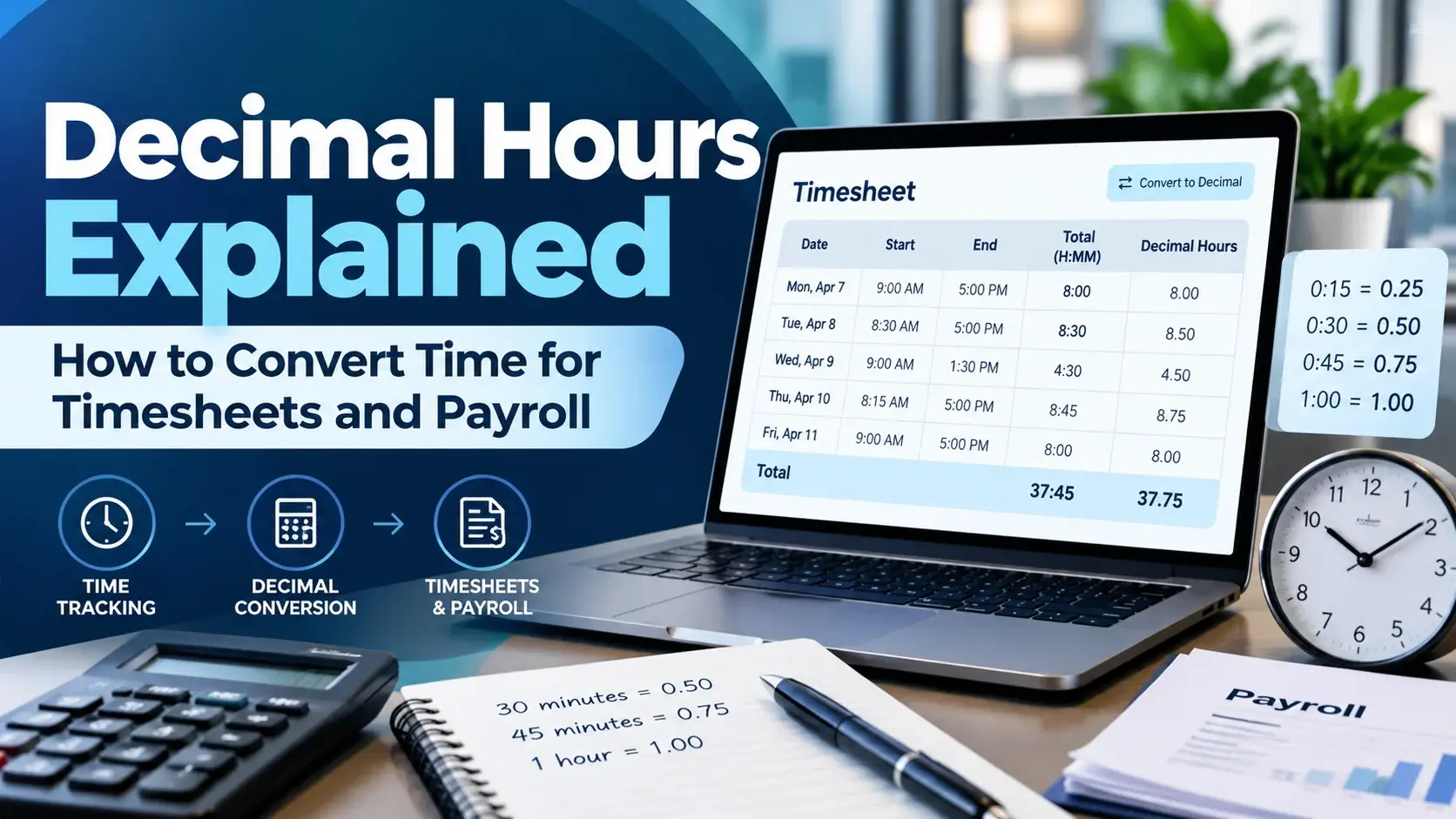
Decimal hours to minutes: multiply the decimal part by 60
0.3 hours = 18 minutes · 0.5 hours = 30 minutes · 0.75 hours = 45 minutes
So 7.75 hours = 7 hours 45 minutes.
Payslips, timesheets and payroll apps often show time as decimals, like 7.75 or 38.3 hours. That is easy for calculating pay, but hard to read when you just want to know how long you worked. This guide shows what decimal hours mean in hours and minutes, how to convert them both ways, and how to check that your timesheet and pay are right.
What Are Decimal Hours (and Why Payroll Uses Them)?
Decimal hours show time as a number of hours with a decimal part, such as 7.5 instead of 7 hours 30 minutes. The catch is that an hour has 60 minutes, not 100. So the number after the dot is a fraction of an hour, not a number of minutes.
Payroll uses decimal time because it makes pay simple to work out: 7.5 hours × $20 = $150. Multiplying "7 hours 30 minutes" by a rate is much harder.
| Part of an hour | Decimal | Minutes |
|---|---|---|
| Quarter hour | 0.25 | 15 min |
| Half hour | 0.50 | 30 min |
| Three quarters | 0.75 | 45 min |
| Full hour | 1.00 | 60 min |
How to Convert Decimal Hours to Minutes (2 Steps)
- Keep the whole number as hours. In 7.75, the 7 is 7 hours.
- Multiply the decimal part by 60. 0.75 × 60 = 45 minutes. Answer: 7 hours 45 minutes.
Minutes = decimal part × 60
Prefer not to do the math? Enter any value in our time converter and it shows the result in hours and minutes and in decimal hours.
How many minutes is .3 hours?
0.3 hours is 18 minutes, because 0.3 × 60 = 18. In the same way, 1.3 hours is 1 hour 18 minutes and 38.3 hours is 38 hours 18 minutes.
More examples
- 6.2 hours = 6 hours 12 minutes (0.2 × 60 = 12)
- 8.33 hours ≈ 8 hours 20 minutes (0.33 × 60 ≈ 20)
- 4.1 hours = 4 hours 6 minutes (0.1 × 60 = 6)
Want to picture these lengths in real life? See how long 100 minutes is, with everyday examples from movies to flights.
Decimal Hours to Minutes Chart
Use this chart to read any decimal on your timesheet at a glance. Bookmark it or print it for quick checks.
| Decimal hours | Minutes | Decimal hours | Minutes |
|---|---|---|---|
| 0.05 | 3 min | 0.55 | 33 min |
| 0.10 | 6 min | 0.60 | 36 min |
| 0.15 | 9 min | 0.65 | 39 min |
| 0.20 | 12 min | 0.70 | 42 min |
| 0.25 | 15 min | 0.75 | 45 min |
| 0.30 | 18 min | 0.80 | 48 min |
| 0.35 | 21 min | 0.85 | 51 min |
| 0.40 | 24 min | 0.90 | 54 min |
| 0.45 | 27 min | 0.95 | 57 min |
| 0.50 | 30 min | 1.00 | 60 min |
How to Convert Minutes to Decimal Hours
To go the other way, divide the minutes by 60. For example, 40 minutes ÷ 60 = 0.67 hours.
Decimal hours = minutes ÷ 60
| Minutes | Decimal hours | Minutes | Decimal hours |
|---|---|---|---|
| 5 min | 0.08 | 30 min | 0.50 |
| 10 min | 0.17 | 40 min | 0.67 |
| 15 min | 0.25 | 45 min | 0.75 |
| 20 min | 0.33 | 50 min | 0.83 |
Freelancer example: your time tracker shows 2 hours 40 minutes. 40 ÷ 60 = 0.67, so you bill 2.67 hours × your hourly rate.
For any other value, use our minutes to hours converter. It shows the answer in hours and minutes and in decimal hours.
7.30 vs 7:30: The Mistake That Costs You Pay
This is the most common timesheet mistake. A colon and a dot look similar, but they mean different amounts of time:
7:30 (clock time)
= 7 hours 30 minutes = 7.50 decimal hours
7.30 (decimal hours)
= 7 hours 18 minutes
If 7 hours 30 minutes is entered as "7.30", you lose 12 minutes that day, which is about 1 hour over a 5-day week.
Check your payslip: if you worked 7 hours 30 minutes and it shows 7.30 hours, ask your payroll team to check. It should show 7.50.
How to Calculate Hours Worked on a Timesheet
- Write the start and end time in 24-hour format (5:07 PM = 17:07).
- Subtract the start time from the end time.
- Subtract any unpaid break.
- Convert the result to decimal hours (minutes ÷ 60).
Here is a full example week:
| Day | In | Out | Unpaid break | Worked | Decimal |
|---|---|---|---|---|---|
| Mon | 8:52 | 17:07 | 30 min | 7 h 45 min | 7.75 |
| Tue | 9:00 | 17:30 | 30 min | 8 h 00 min | 8.00 |
| Wed | 8:45 | 16:45 | 45 min | 7 h 15 min | 7.25 |
| Thu | 9:10 | 18:00 | 30 min | 8 h 20 min | 8.33 |
| Fri | 8:30 | 14:42 | none | 6 h 12 min | 6.20 |
| Total | 37 h 32 min | 37.53 |
Pay example: at $15 an hour, 37.53 hours × $15 = $562.95.
Tip: add up the minutes for the whole week first (2,252 minutes), then divide by 60 once. Adding rounded decimals day by day can make the total slightly off.
Payroll Rounding Rules: Nearest 5, 6 or 15 Minutes
Many employers round clock-in and clock-out times. In the United States, the Department of Labor regulation 29 CFR 785.48(b) allows employers to record start and stop times to the nearest 5 minutes, the nearest tenth of an hour (6 minutes) or the nearest quarter hour (15 minutes), as long as the practice does not, over time, result in workers being underpaid for the time they actually worked.
Quarter-hour example (often called the "7-minute rule"): 1 to 7 minutes past the quarter rounds down, and 8 to 14 minutes rounds up. So 8:52 rounds to 8:45, and 8:53 rounds to 9:00.
Rounding rules are different in each country and company. Check your contract or local labour law. This guide is general information, not legal advice.
Frequently Asked Questions
How many minutes is .3 hours?
0.3 hours is 18 minutes, because 0.3 × 60 = 18.
What is 7.75 hours in hours and minutes?
7.75 hours is 7 hours and 45 minutes, because 0.75 × 60 = 45.
Is 7.30 hours the same as 7 hours 30 minutes?
No. 7.30 hours in decimal is 7 hours 18 minutes. 7 hours 30 minutes is 7.50 hours.
How do I convert minutes to decimal hours?
Divide the minutes by 60. For example, 40 minutes ÷ 60 = 0.67 hours.
What is 0.25 of an hour?
0.25 of an hour is 15 minutes, a quarter of an hour.
How do I calculate total hours worked in a week?
Add up the minutes worked each day, then divide the total by 60 to get decimal hours. For example, 2,252 minutes ÷ 60 = 37.53 hours.
Need a different number? Convert minutes and hours instantly.
Open the Minutes to Hours Converter →Convert and optimize files in seconds
Try our free online PDF, image, audio, and video conversion tools.