Mass is one of the most basic ideas in physics, but it is often confused with weight. In simple terms, mass describes how much matter an object contains and how strongly it resists changes in motion. Whether you are studying science at school, working on a physics problem, or simply trying to understand what kilograms actually measure, learning the meaning of mass provides a strong foundation for many other science topics.
What Is Mass?
The simplest mass definition is that mass is a measure of the amount of matter contained in an object. In physics, mass also describes an object's inertia, meaning its resistance to being accelerated when a force is applied.
For example, pushing an empty shopping cart is easier than pushing one loaded with heavy items. The loaded cart has more mass, so a greater force is needed to produce the same acceleration.
This is why the scientific definition of mass is more useful than simply thinking about whether something feels heavy. Heaviness is related to weight, while mass is an inherent property of the object.
Simple Definition of Mass
If you need a short answer for school or science work: Mass is the quantity of matter in an object and is commonly measured in kilograms.
What Does Mass Mean in Physics?
In physics, mass plays an important role in understanding motion, force, momentum, gravity, and energy. An object with greater mass generally requires more force to change its velocity than an object with less mass.
Newton's second law of motion connects force, mass, and acceleration:
Newton's Second Law
F = m × aForce = Mass × Acceleration
In this relationship, m represents mass. If the same force is applied to two objects, the object with greater mass will usually accelerate less.
Why This Matters
Mass is not just a number on a scale. It helps physicists predict how an object will move when forces act on it.
What Is the Unit of Mass?
The SI base unit of mass is the kilogram, written with the symbol kg. SI stands for the International System of Units, which is the measurement system commonly used in science.
Milligram
Used for very small masses such as medicine ingredients or tiny samples.
Gram
Useful for smaller everyday objects and laboratory measurements.
Kilogram
The SI base unit of mass and a common unit for larger everyday objects.
Metric Tonne
Used for very large masses such as vehicles, machinery, or cargo.
Common Units of Mass
Different units of mass are useful because objects can vary enormously in size. A laboratory sample may be measured in milligrams, food may be measured in grams, and a person or large object may be measured in kilograms.
| Unit | Symbol | Relationship | Common Use |
|---|---|---|---|
| Milligram | mg | 1,000 mg = 1 g | Very small quantities |
| Gram | g | 1,000 g = 1 kg | Food, small objects, laboratory samples |
| Kilogram | kg | SI base unit | People, packages, everyday objects |
| Metric tonne | t | 1,000 kg = 1 tonne | Cars, equipment, freight |
Need to Convert a Mass Measurement?
Mass can be expressed in different units depending on the measurement system and the size of the object. If you need to change a value from kilograms to pounds, grams to ounces, or another common unit, you can use the Weight & Mass Converter to calculate the equivalent value quickly.
How Is Mass Measured?
To measure mass, scientists commonly use a balance or a calibrated scale. A laboratory balance can compare an unknown mass with a known standard, while electronic scales use sensors and calibration to display a mass value.
Basic Steps for Measuring Mass
- Choose a scale or balance suitable for the size of the object.
- Make sure the instrument reads zero before measuring.
- Place the object securely on the measuring surface.
- Wait for the reading to stabilize.
- Record the measurement with the correct unit, such as g or kg.
Examples of Mass in Everyday Life
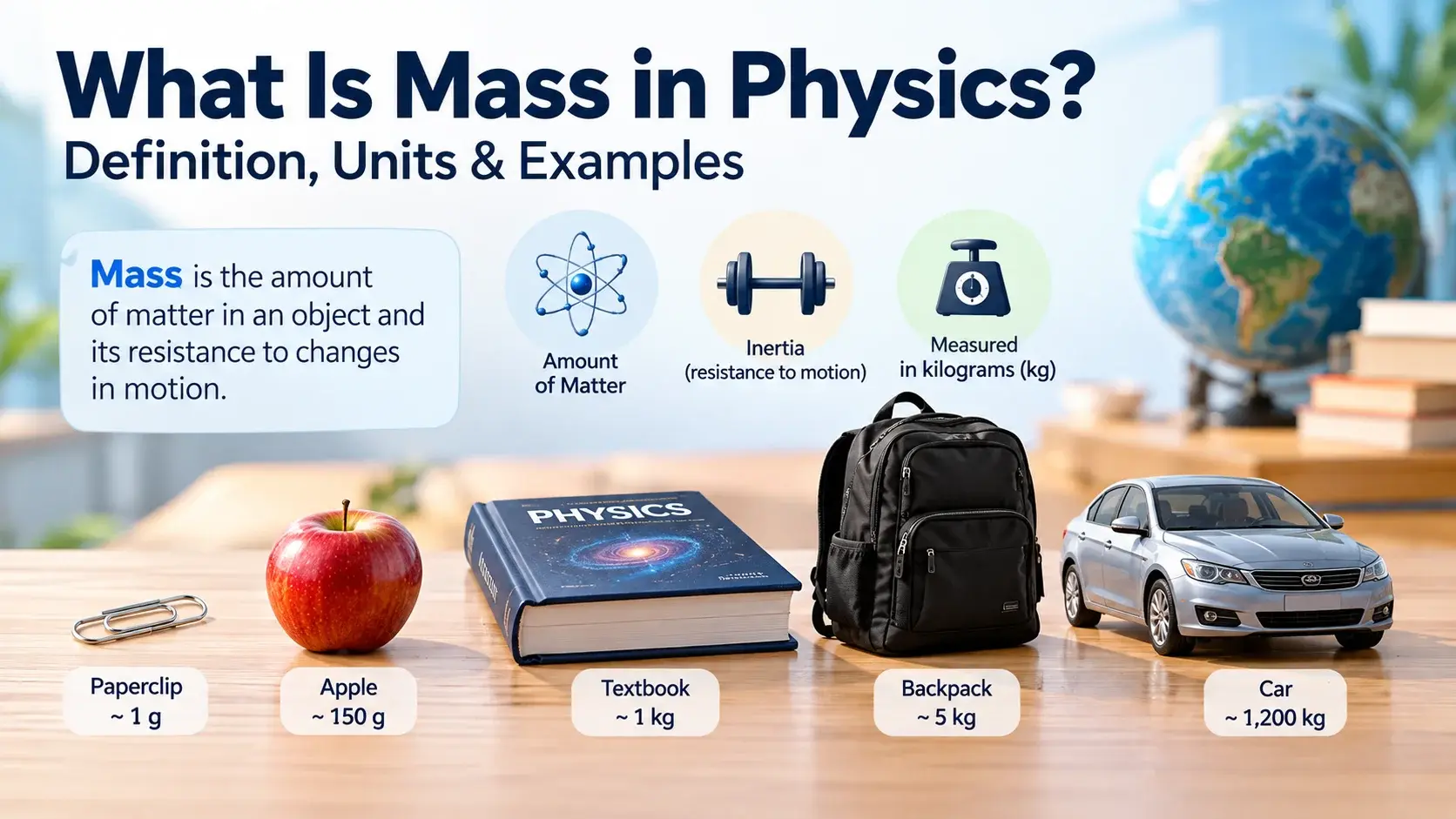
Real-world examples make the meaning of mass easier to understand. The exact values vary between individual objects, but the following examples show how dramatically mass can change from one object to another.
Remember
These are only examples. The actual mass depends on the specific object, materials, size, and contents.
What Is the Difference Between Mass and Weight?
Mass and weight are related, but they are not the same physical quantity. Mass describes the amount of matter and inertia of an object, while weight is the gravitational force acting on that mass.
Mass
- Property of an object
- Measured in kilograms in SI
- Does not depend directly on local gravity
- Related to inertia
Weight
- A force caused by gravity
- Measured in newtons in SI
- Changes when gravitational acceleration changes
- Depends on both mass and gravity
In everyday conversation, people often say that they “weigh” a certain number of kilograms. In formal physics, kilograms describe mass, while weight is a force measured in newtons.
Does Mass Change With Location?
An object's mass remains essentially the same when it moves from one location to another. For example, an astronaut who has a mass of 70 kg on Earth still has approximately 70 kg of mass on the Moon.
The astronaut's weight, however, becomes much smaller on the Moon because the Moon's gravitational field is weaker than Earth's.
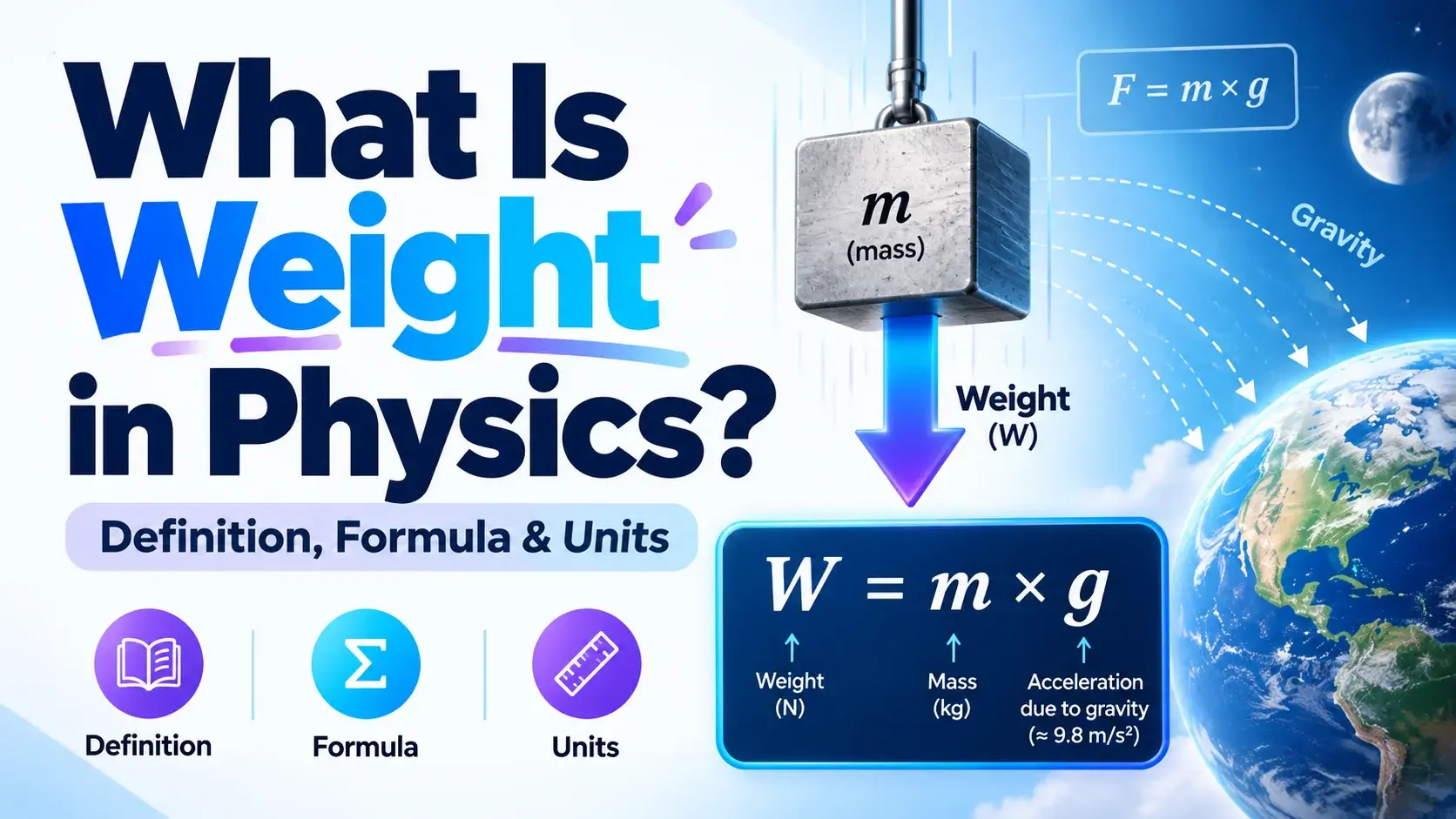
Weight Formula
W = m × gWeight = Mass × Gravitational Acceleration
This equation explains why the same mass can have a different weight in different gravitational environments.
Practical Mass Unit Conversion
Physics, engineering, schoolwork, shipping, fitness, and everyday measurements may use different units. You may need to convert kilograms into grams, pounds into kilograms, ounces into grams, or other combinations.
Convert Different Measurement Units
If your calculation involves measurements beyond mass, such as length, volume, area, temperature, force, or other physical quantities, you can explore the complete collection of online unit converters for additional conversion tools.
Why Is Mass Important in Physics?
Mass appears throughout physics because it affects how objects respond to forces and interact with their surroundings. Understanding mass helps students make sense of several later topics.
Motion
Mass affects how easily an object's velocity can be changed.
Force
Force, mass, and acceleration are related through Newton's second law.
Momentum
Momentum depends on both an object's mass and its velocity.
Gravity
Mass is involved in gravitational interactions between objects.
Mass Definition, Units and Measurement at a Glance
| Definition | Mass describes the amount of matter in an object and its resistance to acceleration. |
|---|---|
| SI Base Unit | Kilogram (kg) |
| Common Smaller Units | Gram (g) and milligram (mg) |
| Common Larger Unit | Metric tonne (t) |
| Measured With | A balance or calibrated scale |
| Different From | Weight, which is a force caused by gravity |
Frequently Asked Questions About Mass
What is mass in science?
Mass is a physical quantity describing the amount of matter in an object and its resistance to changes in motion. Its SI base unit is the kilogram.
What is the scientific definition of mass?
In introductory physics, mass describes an object's quantity of matter and its inertia. Inertia is the resistance an object has to changes in its motion.
What is the unit of mass?
The SI base unit for mass is the kilogram, abbreviated as kg. Grams, milligrams, and metric tonnes are also commonly used.
What is mass measured in?
Mass is commonly measured in kilograms or grams. The exact unit depends on the size of the object and the measurement system being used.
How do you measure mass?
Mass can be measured using a balance or a properly calibrated scale. The instrument should be zeroed before the object is measured.
What are some examples of mass?
A paperclip may have a mass of about a gram, while a book may have a mass approaching a kilogram. People and vehicles have much larger masses measured in kilograms.
Is mass the same as weight?
No. Mass is a property of an object, while weight is the force of gravity acting on that mass.
Does mass change on the Moon?
An object's mass remains essentially the same on the Moon, but its weight is lower because the Moon's gravitational field is weaker than Earth's.
What is the base unit for mass?
The kilogram is the SI base unit of mass.
What is a simple definition of mass?
A simple definition is: mass is a measure of how much matter an object contains.
Final Takeaway
Mass is a fundamental physical quantity that describes the amount of matter in an object and its resistance to acceleration. The kilogram is the SI base unit of mass, while grams, milligrams, and metric tonnes are useful for smaller or larger measurements.
Mass should not be confused with weight. An object's mass remains essentially constant when its location changes, while its weight can change because gravitational strength changes.
Understanding this distinction makes later physics topics such as force, acceleration, momentum, and gravity much easier to learn.