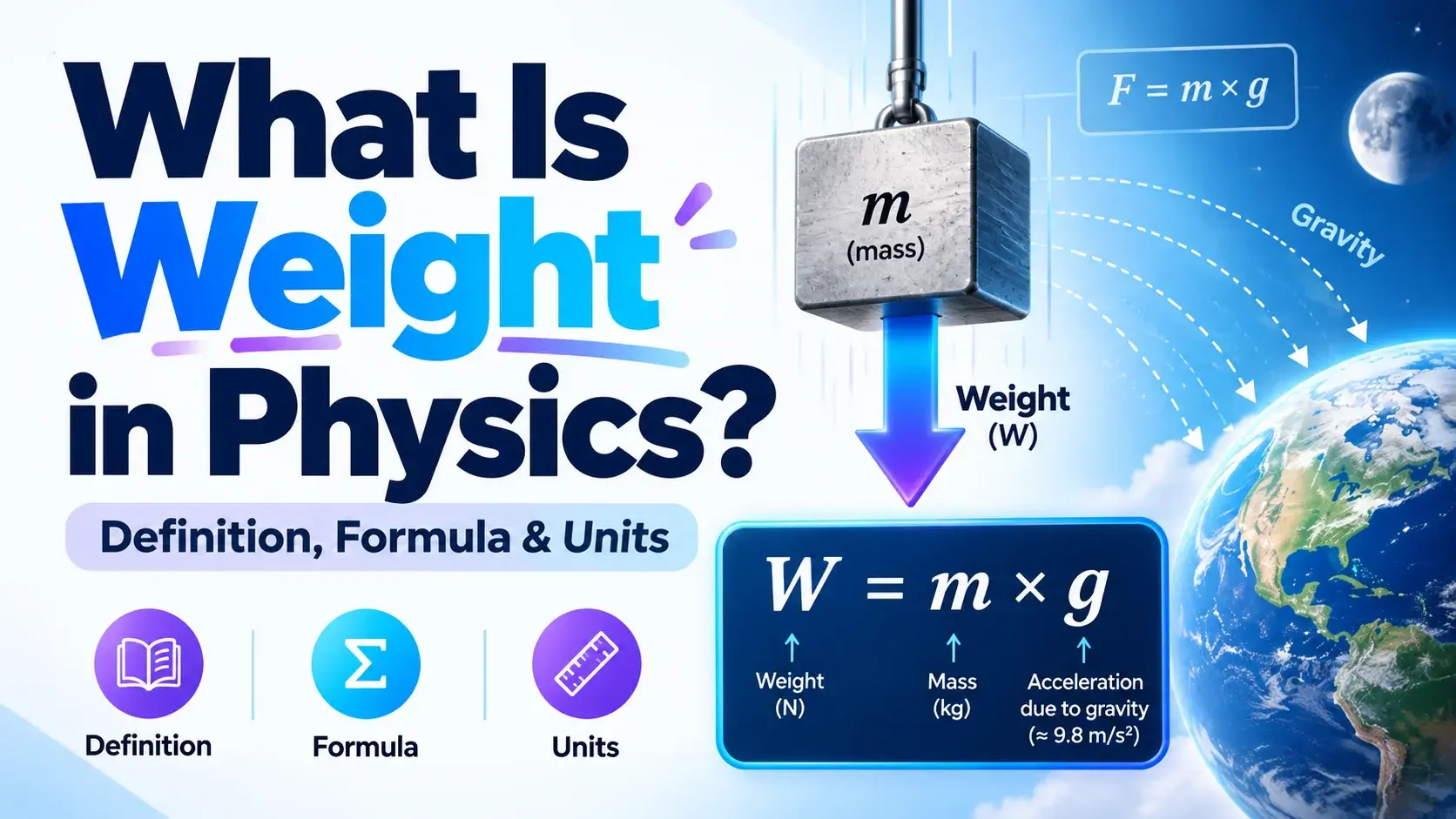
In physics, weight is the force of gravity acting on an object. It depends on both the object’s mass and the strength of the gravitational field where the object is located.
This guide explains the scientific meaning of weight, the weight equation, the unit of weight, how weight differs from mass, and how to calculate weight using simple examples.
Quick Answer
Weight is the gravitational force acting on an object.
The equation for weight is W = m × g, and the SI unit of weight is the newton (N).
What Is Weight in Physics?
The weight definition in physics is the force produced when gravity acts on an object’s mass. Weight is therefore a force, not simply the amount of matter in an object.
For example, a backpack has mass because it contains matter. When Earth’s gravity pulls on that mass, the resulting gravitational force is the backpack’s weight.
Weight is the gravitational force exerted on an object.
Scientific Meaning of Weight
In everyday language, people often use the word “weight” to describe how heavy something is. In science, however, the meaning is more precise.
The scientific meaning of weight is a force caused by gravity. Because gravitational strength can vary from one location to another, an object’s weight can also change.
Its mass, however, remains the same unless matter is added or removed.
Weight Equation: W = mg
The standard equation for weight is:
Weight = Mass × Gravitational Field Strength
This weight equation allows you to calculate the gravitational force acting on an object when you know its mass and the local gravitational field strength.
What Do W, m and g Mean?
W = Weight
Weight is the gravitational force acting on an object. It is measured in newtons.
m = Mass
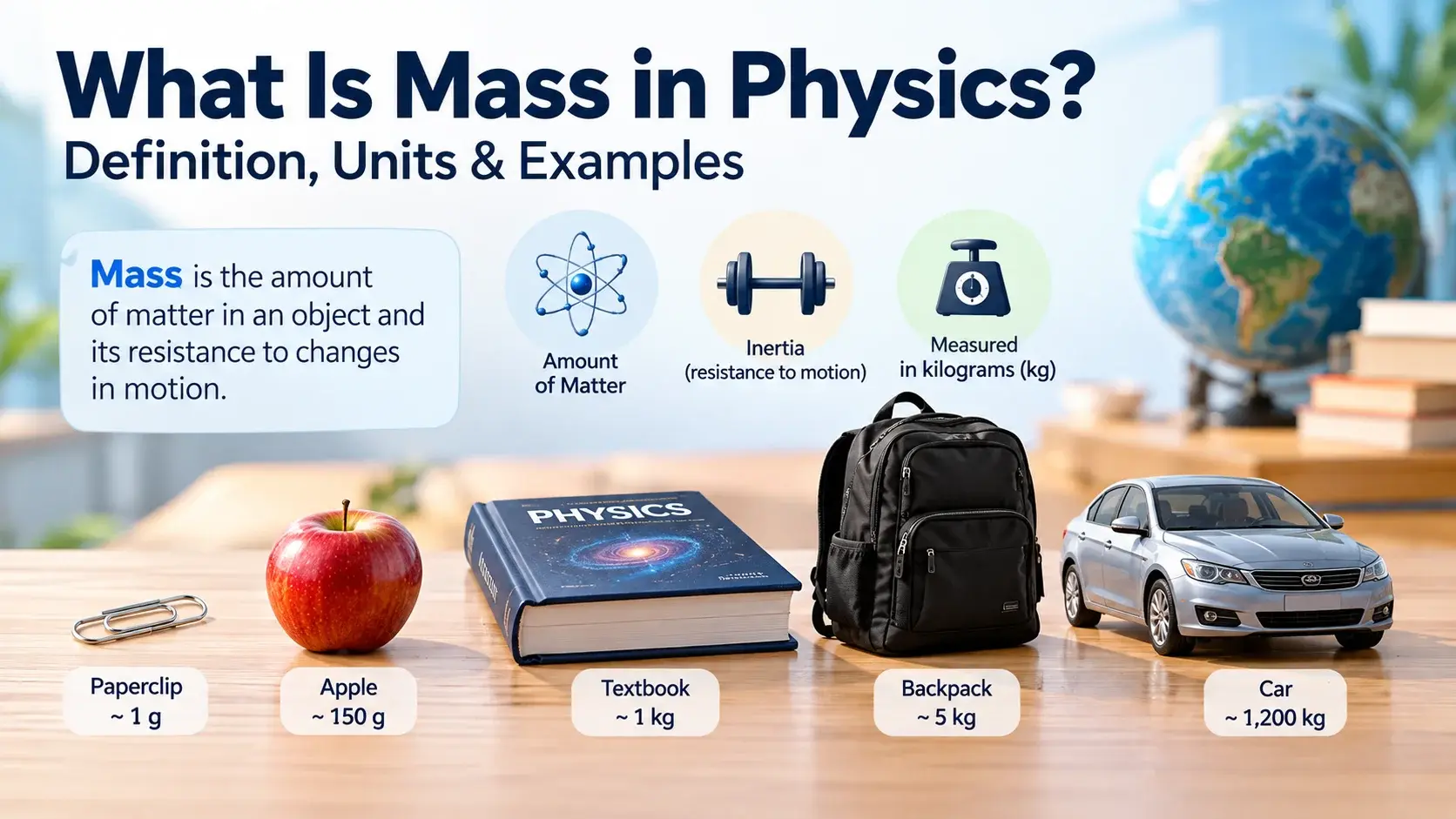
Mass describes how much matter an object contains. It is measured in kilograms.
g = Gravitational Field Strength
Near Earth’s surface, g is approximately 9.8 N/kg.
Some school questions use g = 10 N/kg to make calculations easier. Always use the value given in the question.
What Is the Unit of Weight?
The SI unit of weight is the newton, written with the symbol N.
This is because weight is a force. The newton is the standard SI unit used for force measurements.
| Quantity | SI Unit | Symbol |
|---|---|---|
| Weight | Newton | N |
| Mass | Kilogram | kg |
What Are the Units of Weight in the Metric System?
In physics, the standard unit measurement for weight in the metric or SI system is the newton (N).
Kilograms are units of mass, not weight in the strict scientific sense. If you need to convert between common weight and mass units for everyday calculations, you can use this weight converter.
Mass vs Weight: What’s the Difference?
| Feature | Mass | Weight |
|---|---|---|
| Meaning | Amount of matter | Force due to gravity |
| Symbol | m | W |
| SI Unit | Kilogram (kg) | Newton (N) |
| Changes With Gravity? | No | Yes |
Why Are Mass and Weight Often Confused?
In everyday conversation, people often say something like “I weigh 70 kg.” In strict physics terminology, 70 kg is a mass.
W = m × g
W = 70 × 9.8
W ≈ 686 N
How to Calculate Weight
- Find the mass in kilograms.
- Find the gravitational field strength.
- Multiply using W = m × g.
Example: Weight of a 10 kg Object on Earth
Mass = 10 kg
g = 9.8 N/kg
W = 10 × 9.8
W = 98 N
Therefore, a 10 kg object weighs approximately 98 N on Earth.
Example Using g = 10 N/kg
W = 5 × 10
W = 50 N
Why Does Weight Change?
Weight changes because gravitational field strength is not the same everywhere.
If gravity is weaker, weight decreases. If gravity is stronger, weight increases.
The object’s mass does not change simply because it moves to a place with different gravity.
Weight on Earth vs the Moon
On Earth
g ≈ 9.8 N/kg
Weight ≈ 98 N
On the Moon
g ≈ 1.6 N/kg
Weight ≈ 16 N
The mass remains 10 kg in both places, but the weight changes because the gravitational field is different.
Does Weight Change on Other Planets?
| Location | Approx. g |
|---|---|
| Moon | 1.6 N/kg |
| Earth | 9.8 N/kg |
| Mars | 3.7 N/kg |
| Jupiter | About 24.8 N/kg |
How Do We Measure Weight?
- Spring scales
- Force meters
- Newton meters
Many household scales respond to force but are calibrated to display an estimated mass in kilograms.
Common Mistakes About Weight
- Saying weight is measured in kilograms: kilograms measure mass; newtons measure weight.
- Confusing mass and weight: mass and weight are related but are not the same quantity.
- Forgetting g: use W = mg.
- Using grams directly: convert grams to kilograms first.
- Assuming weight is the same everywhere: weight depends on gravity.
- Leaving off the unit: weight should normally be written in newtons.
Weight Formula Summary
| Quantity | Symbol | Unit |
|---|---|---|
| Weight | W | Newton (N) |
| Mass | m | Kilogram (kg) |
| Gravitational Field Strength | g | N/kg |
FAQs About Weight in Physics
What is the definition of weight in physics?
Weight is the gravitational force acting on an object.
What is the equation for weight?
The equation is W = m × g.
What is the SI unit of weight?
The SI unit of weight is the newton (N).
Is weight measured in kilograms or newtons?
In physics, weight is measured in newtons. Kilograms measure mass.
Weight in Physics: Key Takeaways
- Weight is a force caused by gravity.
- The equation for weight is W = mg.
- Weight is measured in newtons (N).
- Mass is measured in kilograms (kg).
- Weight changes when gravitational field strength changes.
For other measurement and unit conversion tools, you can also explore OnlineConverter.online.
Bottom Line
In physics, weight is the force of gravity acting on an object. Use W = m × g to calculate it, and express the result in newtons (N).